

 Have you ever spent hours wondering why someone hasn’t texted you back?
Maybe you’ve replayed a conversation over and over, convinced you said something wrong. Or perhaps you’ve caught yourself pulling away from someone just as the relationship started becoming more serious.
If you’ve ever wondered, “Why do I react this way in relationships?” you’re not alone.
While it’s easy to blame ourselves for being “too emotional,” “too needy,” or “too distant,” these reactions often have much deeper roots. The way we experience closeness, conflict, and emotional safety is influenced by something psychologists call attachment style.
Understanding your attachment style doesn’t excuse unhealthy behaviors, but it can help explain why relationships sometimes feel so emotionally exhausting and why anxiety often shows up when connection matters most.
Relationships Often Activate Old Wounds
One of the hardest things about anxiety is that it rarely announces itself.
Instead, it quietly changes the way we interpret situations.
A delayed text suddenly feels like rejection.
A partner needing space feels like abandonment.
A disagreement feels like the beginning of the end.
Even when there is little evidence that something is wrong, your mind may begin filling in the blanks.
This isn’t because you’re “crazy” or “too sensitive.”
It’s often because your nervous system has learned to expect uncertainty or disappointment based on past experiences.
Understanding Attachment Styles
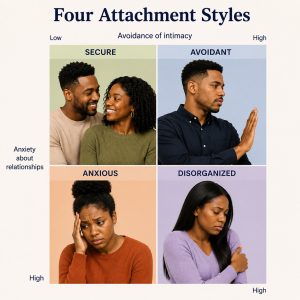 Attachment theory suggests that our earliest relationships teach us what to expect from other people.
Were our caregivers emotionally available?
Did we feel safe expressing our needs?
Were our emotions validated or dismissed?
Those early experiences often become the foundation for how we navigate relationships later in life.
While everyone’s experiences are unique, psychologists generally describe four attachment styles.
Secure Attachment
People with secure attachment generally believe they are worthy of love and that others can be trusted. Conflict feels uncomfortable, but it doesn’t automatically threaten the relationship.
Anxious Attachment
People with anxious attachment often crave closeness but worry about losing it. They may seek reassurance, overanalyze interactions, or fear being abandoned.
Avoidant Attachment
Individuals with avoidant attachment often value independence and self-reliance. They may struggle with vulnerability and feel overwhelmed when relationships become emotionally intense.
Fearful-Avoidant Attachment
This attachment style often feels like wanting closeness while simultaneously fearing it.
Someone may deeply desire connection but become overwhelmed once they begin feeling emotionally vulnerable.
The result is often a confusing push-and-pull pattern within relationships.
Anxiety Doesn’t Always Begin in the Present
One of the most important things to understand is that relationship anxiety isn’t always about the relationship you’re currently in.
Sometimes your partner isn’t triggering your anxiety.
Your past is.
For example, someone who grew up experiencing inconsistency may become hyperaware of small changes in someone’s mood.
Someone who experienced criticism may become overly sensitive to feedback.
Someone who felt emotionally rejected as a child may interpret normal independence as abandonment.
These reactions often happen automatically because your brain is trying to protect you from being hurt again.
Unfortunately, those protective strategies can sometimes create distance in otherwise healthy relationships.
When Anxiety Starts Running the Relationship
Relationship anxiety can show up in many different ways.
You might find yourself:
- Constantly seeking reassurance
- Reading into text messages
- Assuming the worst before asking questions
- Avoiding vulnerability because it feels unsafe
- Becoming overwhelmed after conflict
- Pulling away before someone else has the chance to leave
None of these behaviors mean you’re incapable of healthy relationships.
They simply suggest that your nervous system may still be operating from old survival strategies.
Recognizing these patterns is often the first step toward changing them.
Healing Begins with Self-Awareness
One of the biggest misconceptions about attachment is that it’s permanent.
It isn’t.
Our brains remain capable of learning throughout adulthood.
With consistent self-awareness, healthy relationships, and intentional work, many people develop what’s known as earned secure attachment.
This doesn’t mean you’ll never feel anxious again.
It means anxiety no longer controls your relationships.
Healing often looks like:
- Becoming curious instead of reactive.
- Learning to tolerate uncertainty.
- Communicating needs directly.
- Building self-trust.
- Practicing self-compassion during difficult moments.
These changes don’t happen overnight, but they are absolutely possible.
The Most Important Relationship Is the One You Have With Yourself
 It’s easy to focus on changing other people.
We often think,
“If they communicated better, I wouldn’t be anxious.”
“If they reassured me more, I’d finally feel secure.”
While healthy communication certainly matters, lasting security usually begins within ourselves.
Learning to trust your own judgment.
Believing your needs matter.
Knowing your worth even when relationships feel uncertain.
The healthier your relationship with yourself becomes, the less anxiety tends to dictate your interactions with others.
How Therapy Can Help
Attachment wounds can feel deeply personal, but they are not permanent.
Therapy offers a safe, supportive space to better understand how your past experiences continue to influence your present relationships. Together, you and your therapist can identify attachment patterns, strengthen emotional regulation skills, challenge anxious thought patterns, and develop healthier ways of connecting with yourself and others.
Start Working With a Relationship Therapist in Brooklyn, NY
Whether you’re struggling with relationship anxiety, difficulty trusting others, or feeling overwhelmed by emotional closeness, healing is possible.
Secure relationships don’t begin with finding the perfect partner; they begin with understanding yourself.
If anxiety has been affecting your relationships, working with a relationship therapist can help you build the confidence, self-awareness, and emotional security needed to create healthier, more fulfilling connections. You can start your therapy journey with SG Wellness by following these simple steps:
- Contact us to schedule a free consultation.
- Meet with a caring therapist
- Start creating healthier attachment styles!
Other Services Offered with SG Wellness
At SG Wellness, we offer a range of mental health services to support you wherever you are. In addition to individual relationship therapy, we provide depression treatment, individual therapy, young adult therapy, self-esteem therapy, and group therapy. All of our services are available via online therapy in New York. We proudly serve Brooklyn, Bed-Stuy, The Bronx, Queens, and surrounding areas. When you’re ready, we’re here.
Recent Comments